Cold Hope is Cold Faith
By David Pineda
| Aug 22, 2026
Without faith there is no hope and without hope there is no faith But if both are missing?
What do you do when all hope is lost?
The critical thing for the human spirit has always been hope. It is the last thing we ever—and possibly ever can—abandon. Some have, and tragic decisions are always made. What is so critical about hope, then?
In light of the Catechism of the Catholic Church, hope is a fire which keeps our faith boiling:
“Hope is the theological virtue by which we desire the kingdom of heaven and eternal life as our happiness, placing our trust in Christ’s promises and relying not on our own strength, but on the help of the grace of the Holy Spirit.” (CCC 1817)
It could be likened to a group of people surrounding a burning pot of stew. The fire is strong, and it creates a flowing aroma which reaches every person, excitedly waiting for what presently smells and tastes like the best stew ever!
Hope is the fire which keeps our faith attractive and active. It is what makes faith desirable and worth waiting for. It is what makes present the faith’s richness. Without hope, the stew is cold and unattractive as we sit around a cold fire for a dish that will be served cold. If you’re a foodie like me, there can be no worse disappointment for a dish you know will be unsatisfactory.
There are different spheres to hope: God, work, relationships, and many others, but these are the most common ones. If we lose our faith in God, there is no telling what sort of damage might be done. We might lose hope in a better life, ourselves, our families, or our futures. This is especially true for those who grow disappointed after years of keeping faith.
If we lose hope in God, we stand to lose hope in everything else.
Faith is an internal yes within us that is kept alive by the hope we have in that faith. And without faith, there is nothing rightly ordered in our hope. Thus, we hope to acquire worldly things. And if we finally abandon our hope, we stand to lose the very thing that saves us: our faith.
Therefore, St. Paul says:
“Therefore, since we are justified by faith, we have peace with God through our Lord Jesus Christ. Through him we have obtained access to this grace in which we stand, and we rejoice in our hope of sharing the glory of God” (Romans 5:1-2).
Conversely, though, it would be wrong to say that our faith depended on hope. Our faith is never really ours. But if the faith we’ve been given grows stronger, our hope is likewise nourished. From the analogy of the stew, this can be seen as learning, while the stew burns with a low heat, that it contains the best ingredients of the highest quality, and thus it motivates the rest of us to kindle the fire!
Thus, St. Paul writes of Abraham:
“No distrust made him waver concerning the promise of God, but he grew strong in his faith as he gave glory to God, fully convinced that God was able to do what he had promised” (Romans 4:20–21).
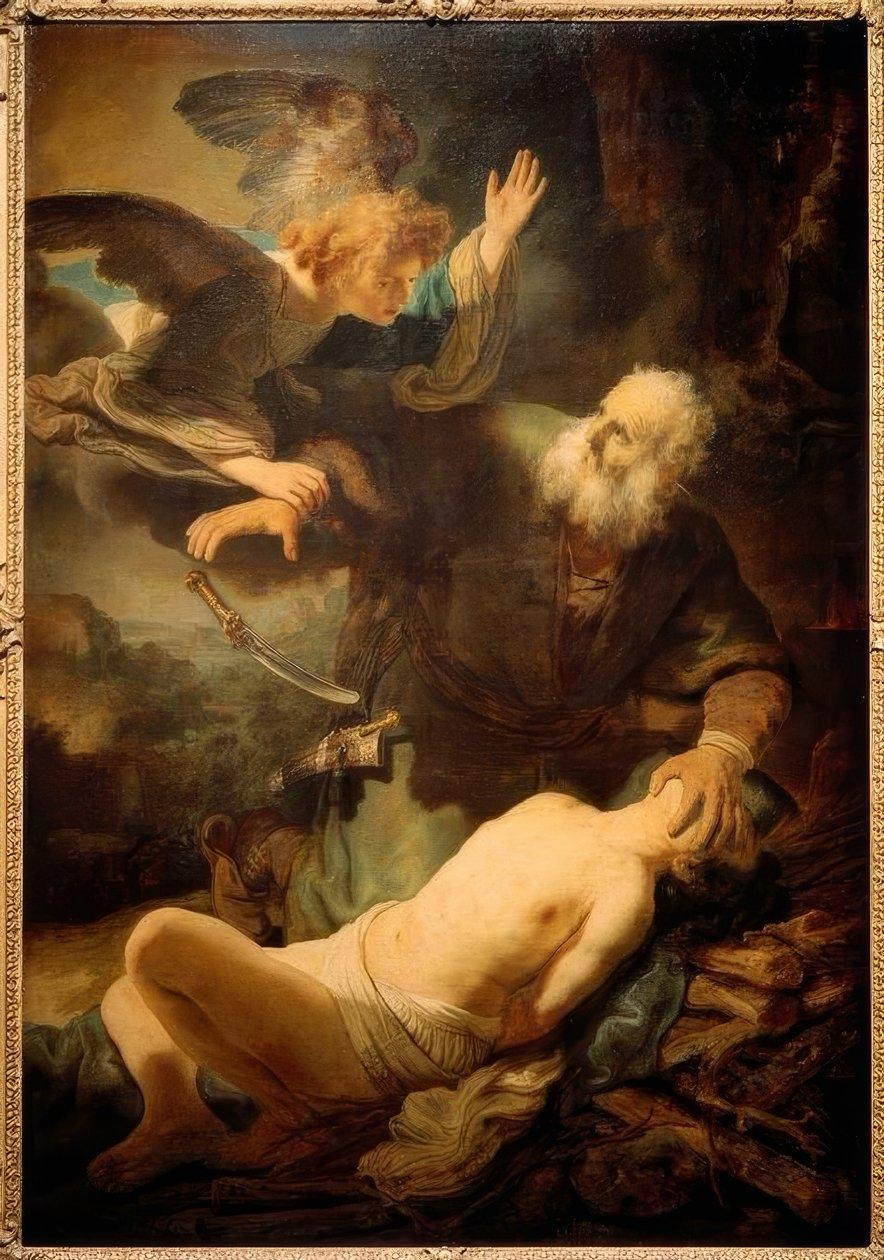
(Rembrandt van Rijn, Abraham and Isaac, 1645)
Yet if both city and king have been dissimated and are in oblivion, what are we to do? If the state our lives has reached is a collapsing point, what can explain the turning back without hope and faith?
Well, in my experience, it has always been fear. If charity has not been nourished, since it is the highest virtue and, as a consequence, difficult to perfect, especially when we have lost the other two theological virtues, most commonly it is always servile fear.
We are full of agendas and dreams that exist underneath the veil that is God. If hope and faith are lost in God, we stand to lose what our agendas hold most dearly: either school, a career, or a relationship. And to those who are lukewarm, we understand that these are compromised if we stray away from God. We intellectually understand that God must act as a balancing equilibrium. Fear of loss or punishment drives us back to Him.
However, this is not to be dismissed. It is still a beginning. God might be using that fear.
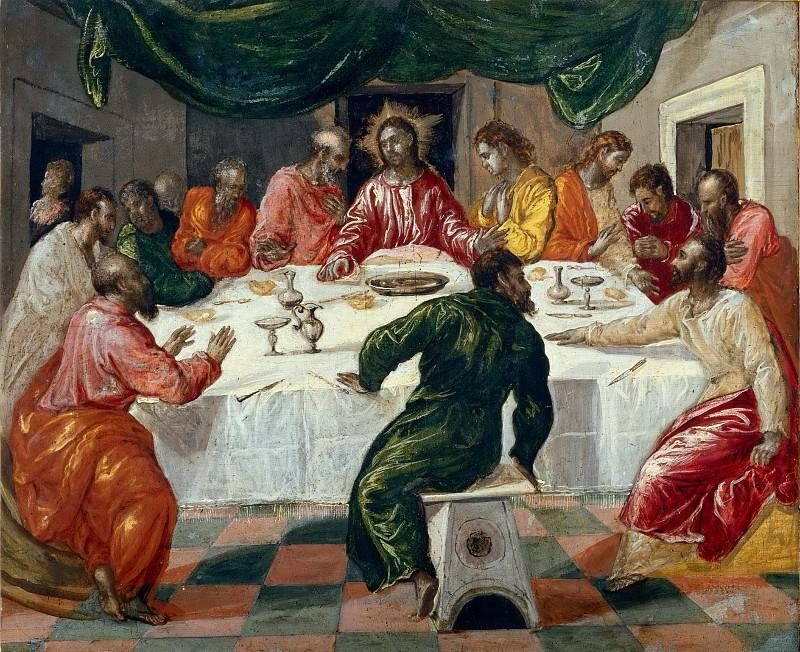
(El Greco, The Last Supper, c. 1568-1569.)
To continue with the nourishment of these two virtues, we must understand that there are indeed practical ways to grow them. And that is through the sacraments and prayer. In my experience, the strongest igniters of faith have been the Eucharist and Confession. When we receive the Eucharist, we receive actual communion with God through the Body and Blood of Christ. Our hope, and the rest of our lives, are nourished by the divine life of God.